Mar 052013
 

the1bigthing.com - change how you think

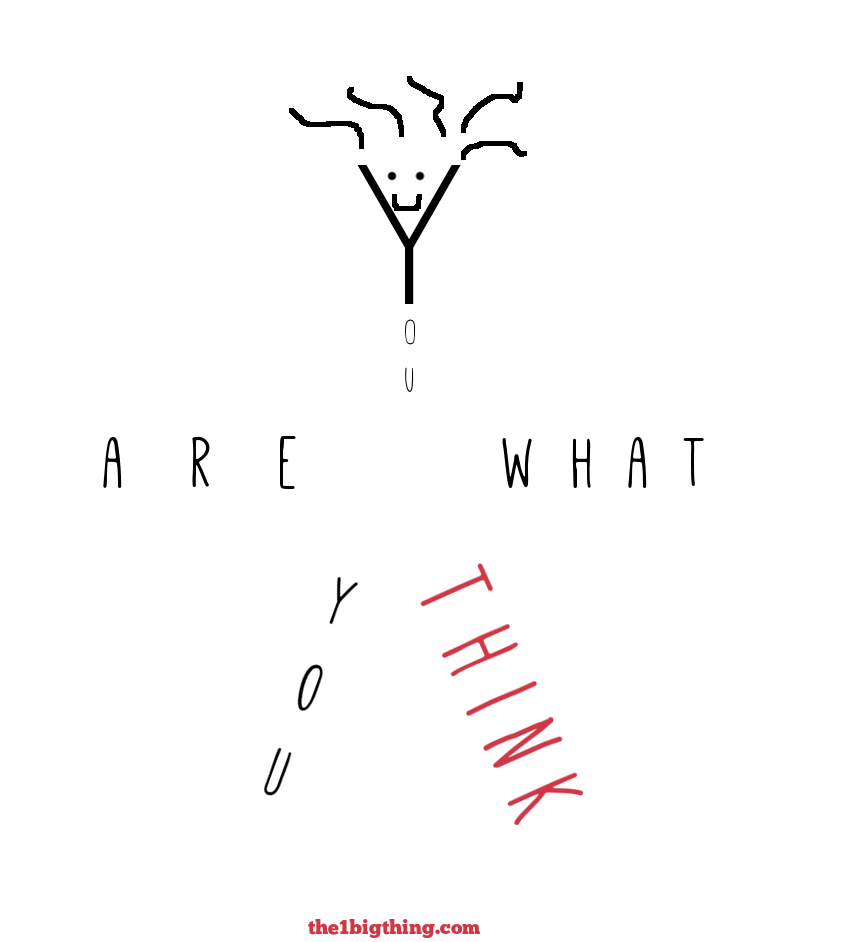
In the past 15 years Psychologists have turned their attention to what makes us happy in life. The research is loud and clear, your thinking has a huge impact on this. This post looks at what the research shows is ‘good’ thinking, what is not and shows an easy way to change how you think.

A group of us were discussing the idea of luck during a workshop I was running. One participant piped up, ‘I not one of those lucky ones, I’ve never been lucky and probably never will.’

It was a typical response from someone who has a pessimistic explanatory style. The bad news for this participant is that his thinking makes him right.

When doing research for a book called ‘The Luck FactorRichard Wiseman discovered that people who considered themselves lucky in one area of their life, were usually also lucky in other areas. This led him to believe that luck is not something that occurs randomly, but instead it’s something that people create through their thinking.

Enter Martin Seligman, the father of Positive Psychology, with a fantastic explanation as to the kind of thinking that creates luck in our lives.

We’ve all heard the terms optimist and pessimist, but what do they exactly mean? Seligman studied the patterns of thinking of hundreds of individuals and noticed that people could explain events in two different ways.

Imagine you’ve thrown a dinner party and the food you’ve cooked has been exquisite. The night was a roaring success and all the guests told you how much they loved it.

If you’re an optimist you might think something along the lines of, ‘Wow I’m a great host and a great cook. I’m sure this party was the start of many great evenings with my friends. And you know what, I’m sure I can use these same skills to turn that work event I’m planning into a huge success as well.’

In other words you’ve built up the event. You’ve made it permanent (you can repeat it), you’ve made it personal (it was YOUR skills that created the success) and you’ve made it universal (you’ve applied it to other areas of your life). As a result you feel great!

If you’re a pessimist your thinking might be a little different. You might say to yourself, ‘That was a fluke. I’ll never be able to re-create that food. There was something in the air that made everyone have fun’.

In other words, you’ve played down the event. You’ve made it temporary (you cannot repeat it), you’ve made it external (you had nothing to do with the success) and you’ve kept it specific (you haven’t applied it to other areas of your life). Chances are it hasn’t given you the same boost that the optimist got.

What about when something negative happens? This is where it gets even more interesting. Seligman found that in a negative event the exact opposite happens.

Let’s imagine you’ve applied for a job and you’ve just received a rejection letter.

An optimist would think something like, ‘It was only one job, they probably needed different skills. I’m sure I’ll do better in my other applications.’

The pessimist might think, ‘This is a disaster. I’m sure I’ll be rejected in my other applications too. I’m just not good enough.’

This time the optimist has made the event temporary, external and specific, while the pessimist has made it permanent, personal and universal. As a result the optimist might shrug the incident off, while the pessimist might end up feeling very disheartened about it.

When we break down the idea of optimism and pessimism in such a way it becomes much easier to see why research shows that optimists do better at work, live longer and report more fulfilling lives.

If you like the sound of this, here’s what you can do to think more optimistically in life.

When something good happens ask yourself the following questions:

  1. What part did I play in making this a success?
  2. How can I apply these skills to other areas of my life?

When something bad happens ask yourself these questions making sure you find reasons to say NO to each question:

  1. Is this permanent?
  2. Is this widespread?
  3. Is this personal?


You might want to follow this line of questioning with:

What specific action can I take to get a better result next time?

Psychologists also recommend that we avoid ‘catastrophising’ negative events. Here are two more questions to help with that.

  1. Will this matter in 5 years’ time?
  2. What are the overall consequences? And why are these not as bad as they seem on the surface?

Hope this post helps you think more optimistically about events that happen in your life.

What current event will you apply this strategy to?

With love

Karen

x


Enhanced by Zemanta
Dec 122011
 

Welcome to the second experiment of this series.

We’re going to look at another experiment that has been shown to increase our happiness. It’s perfect for this time of the year as it’s all about giving, with a difference. So if we do decide to try this one out, it will have the added benefit of adding more meaning to this festive season, which unfortunately has become more about buying stuff than spreading goodwill.

The experiment

One of my favourite happiness psychologists Sonja Lyubomirsky got a group of people to perform five non-financial acts of kindness a week for 6 weeks. At the end of the 6 week period the research team found that all participants reported increased levels of happiness.

What was even more interesting however was that the participants who did all five acts of kindness on a single day every week increased their happiness by an amazing 40%! Wow!


Why it works

Neuroeconomist (yep it’s a profession) William Harbaugh found that when we see ourselves giving to others it activates a part of our brain that is usually activated when our basic needs, such as eating tasty food, are met. It’s pretty awesome to think that there is a direct link between giving to others and happiness in our brains.


What to do

Rate your current level of happiness on a scale of 1 to 10. With 1 being ‘very unhappy’ and 10 being ‘extremely happy – couldn’t be any happier’.

Brainstorm for 10 minutes, 30 acts of kindness that you could do throughout the day. They could be as simple as making someone a coffee, helping a tourist who looks lost, stopping to let another driver get out of a side street, giving blood, singing carols in an old people’s home…the list is endless.

Decide which day of the week is going to be your ‘great virtue and kindness’ day. On that day look for opportunities to carry out 5 of your acts.

Repeat for 6 weeks.

Rate your levels of happiness once more. Ta Daaa you’re officially a kinder and happier version of yourself.

I would love to hear what acts of kindness you’re planning on doing, or have done. Please comment on this blog or e-mail me at [email protected]

Nov 232011
 

We’ll kick off this series with an experiment that has been shown to increase our levels of happiness. (If you don’t know what this series is about you can read the intro here.)

For those of us in the Northern hemisphere winter is well and truly on it’s way, the European economy makes the Dickens era look glamorous and so a little cheering up might be just what we need.

The experiment

This experiment was carried out by psychologists Robert Emmons and Michael McCullough. They found that people who listed 5 things they were grateful for, on a regular basis reported higher levels of happiness and felt more optimistic about life in general. Interestingly they also reported exercising more (which in itself has also been found to increase our level of happiness).

Why it works

Do you know how when we wear a new perfume we can really smell it on us, but after using it for a while we can hardly tell when we’re wearing it? Apparently just like we get used to our perfume, we’re also conditioned to get used to the good things in our lives. Keeping a journal about the things we’re grateful for is a way of reminding ourselves about the good things that already exist in our lives.

What to do

For the next 10 days, keep a gratitude journal. Write 5 things you are grateful for - it could be big things, like your relationship, or little things like managing to get the train in the morning.

Write your journal at the same time each day - to create a little routine.

The important thing is not to treat it as a chore. Further research showed that when people felt that they HAD to write the journal they got no benefit from it at all.

Before starting the journal, as well as 10 days after starting the journal, rate the following statements on a 1 to 10 scale as follows:

1: Very much unlike me, 5: Somewhat like me, 10: Very much like me
  1. In general I would consider myself a happy person
  2. I feel optimistic about what life holds in store for me
  3. I exercise for 30 mins at least 3 times a week.
Remember to keep note of your ratings so you can compare your initial answers with those you give 10 days later.
Once you’ve done the experiment please comment on this blog whether keeping the journal
  • improved your ratings
  • worsened your ratings
  • there was no change
If you prefer you can also e-mail me your thoughts at [email protected]
Enjoy!
xx
Nov 222011
 

Experience has taught us to mistrust anything that offers high returns for very little effort. Get rich quick schemes, politicians’ promises and instant inch loss treatments all induce a rolling of the eyes, followed by a ‘yeah right’ response from us.

But what if experience was sometimes wrong? What if we could actually improve BIG things, like our happiness levels, our relationships, what we achieve in life with very little effort?

And before you roll your eyes and go ‘Pah’, hear me out.

My forays into Psychology journals and Science books have turned up scores of experiments testing this very idea. The result - loads of little actions we can take that have been proven to deliver great returns in our lives.

But why take the psychologists’ word for it? Let’s try these experiments ourselves. Taking part is simple:

  • Every month I’ll publish a single action we can take to improve an area in our lives.
  • Only actions which take 15 minutes or less to carry out will be selected - we’re very busy people after all!
  • We privately rate how we feel in that particular area
  • We try the action out for 10 days
  • Ta daaaa! Hopefully some magic has happened. Just to be sure, we rate the same area a second time to check if there really has been an improvement.
  • We share our results so we can tell the world which actions are worth doing.
If you’d like to take part you can sign up here. If you’ve already signed up to my blog you’ll automatically receive updates about the experiments so there’s no need to sign up again.
Let’s get testing!
With Love
Karen
xx
p.s. You can find Experiment 1 (the gratitude journal) here

Switch to our mobile site