May 132013
 

English: Small plants grow in the blazing Carr...

How to succeed when you feel like giving up

Let’s face it. Following a big dream isn’t easy. It involves a lot of risk and effort nicely combined with a huge chunk of uncertainty. While we often read of inspiring achievements and fantastic results, we rarely hear about the sleepless nights, the bouts of confusion, the knock-backs and the anxiety.

The truth is, if it was easy to make a big dream happen we’d all do it. There are many would rather keep on living in the ‘land of blah’ than put themselves in a situation that involves so much discomfort. Others try but when things going awry, give up and revert back to the safe old ways.

So what is it that pushes others all the way, what helps them achieve what they want regardless of what gets in their way?

Enter Salvatore Maddi, a psychologist who spent 12 years studying what helped people thrive in a difficult environment and we get our answer.

While we might think that success in a tough environment is related to intelligence or experience or luck, Dr. Maddi discovered that it is related to something different. All the people who thrived in a tough environment had one key thing in common and that key thing was RESILIENCE.

With resilience there’s some bad news and some good news.

People who have faced a lifetime of adversity show higher levels of resilience. This is probably why we often hear of super-stars who attribute their difficult childhood to their determination to succeed - Oprah Winfrey is a great example of this.

The bad news is that if you’ve had an easy life so far, chances are you may need to work on your resilience.

The good news is that resilience is a SKILL that we can all learn and develop. It’s not something that we’re either born with or without but something that we can nurture and grow.

So here are some quick tips you can use to help you feel more resilient when the going gets tough.

Resilience-building tips

Identify your resilience-killing thinking

Are you telling yourself that you can’t cope or that you’ve got everything to lose? Write these thoughts down and check whether you’re being realistic or a tad dramatic.

Replace them with resilience building thoughts.

Consider someone you know, or know of, whom you think would deal with this in a resilient way. (Richard Branson always works for me). Channel this person and think of what their thinking would be in this situation.

Take control

Focus on 1 action you can take to help you move forward and go do it. When it’s done focus on 1 more action and repeat.

Connect

This is especially important if you’re feeling isolated. Talk to someone who you know can make you feel better. Join a group of like-minded people and ask for support. (Incidentally I have created a Facebook Group for people who are following big dreams – e-mail me at [email protected] if you’d like to join and I’d be thrilled to add you to the group).

I hope you find these tips useful and I’d love to hear how you’ve used them.


What other strategies do you use to stop yourself from giving up? Share these in the comments below - you might make a huge difference in someone else’s life.


Enhanced by Zemanta
Apr 162013
 

the1bigthing.com

Failure will never overtake me if my desire to succeed is strong enough.

Og Mandino

When I have conversations with people about something they would love to do but haven’t started yet there is often an underlying theme. Whilst outwardly people will say ‘I don’t have the time’ or ‘I don’t have the money’, inwardly they’re thinking ‘I could never succeed’.

Psychologists use the word ‘self-efficacy’ to describe our belief in our ability to achieve the goals we set ourselves. Research shows that when people have a high level of self-efficacy they are more likely to succeed in achieving these goals.

No surprise there. The self-fulfilling prophecy comes into full affect. You want to start an online business but you don’t quite believe you can succeed, that is to say – your self-efficacy is low. You put up your site and get little traffic. You immediately take this as a sign. ‘I knew I’d be no good at this’, or ‘I knew this wouldn’t work’. Chances are, those thoughts will make you feel quite helpless, like you have no control over the situation. As a result you are less motivated to try other things to attract customers to your site and so you enter this downward spiral that will take you further and further away from the success you desire.

The good news is that we can spin this on its head. If we look at what creates a sense of self-efficacy within us we can carefully apply these to any project we undertake. Read on to find out how to triple your chances of success.

There are 4 key things that can increase our self-efficacy. Let’s look at each one in turn and see how we can use it to our advantage.


1. Experiencing a sense of mastery

We feel this when we overcome a challenge successfully. This sense of mastery gives us the confidence and encouragement we need to keep striving.

Apply it by:

Break down your project into smaller manageable challenges. If you set yourself challenges that can be accomplished in an hour, a day, or a week you will get frequent bursts of positive reinforcement that will keep you going


2. Seeing others succeed

When we see others succeeding it increases our own self-efficacy as it gives us the message that ‘this can be done’. This is especially effective when we see ourselves as similar to the person who has succeeded.

Apply it by:

Spend time with people who are following a similar project. Find people who are a few steps ahead of you. Talk to them about their experiences. Consider starting a mastermind group. (A word of caution: Watch out for comparing yourself to people who are years ahead of you in their project as this could end up discouraging you. Remember to avoid comparing the seed of your idea to the fully grown plant that has had years to develop in someone else’s hands).


3. Surround yourself with supporters

Once again this has to do with the people you surround yourself with. When people encourage us and believe in our ideas we feel a lot more confident, capable and motivated to succeed.

Apply this by:

Avoid the ‘nay’ sayers. Be protective of your dreams and ideas. Only share them with people who will support them. If a partner or a loved one is not being supportive make a request. Tell them that what you need now above all else is their support, not their advice.

When someone puts down your dreams and ideas there could be a million reasons behind it. It is often about their own fears, pre-conceptions, assumptions, bitterness, lack of knowledge, world view, BUT RARELY about your idea. Please remember this.


4. Interpretations of your physiology

When you’re doing something challenging you are likely to experience ‘butterflies in the stomach’. How you interpret these will have an effect on your levels of self-efficacy.

Apply this by:

Instead of interpreting butterflies as fear, impending doom, and a sign that you can’t succeed, look at them as excitement, a normal reaction to leaving the comfort zone and a sign that you are stretching yourself and moving forward. Physiologically there is no difference between fear and excitement, your interpretation is what creates it.


I hope you find these tips useful in helping you believe in your ability to succeed. Now that you how to increase your self-efficacy what BIG thing will you start?


Related articles

Enhanced by Zemanta
Mar 052013
 

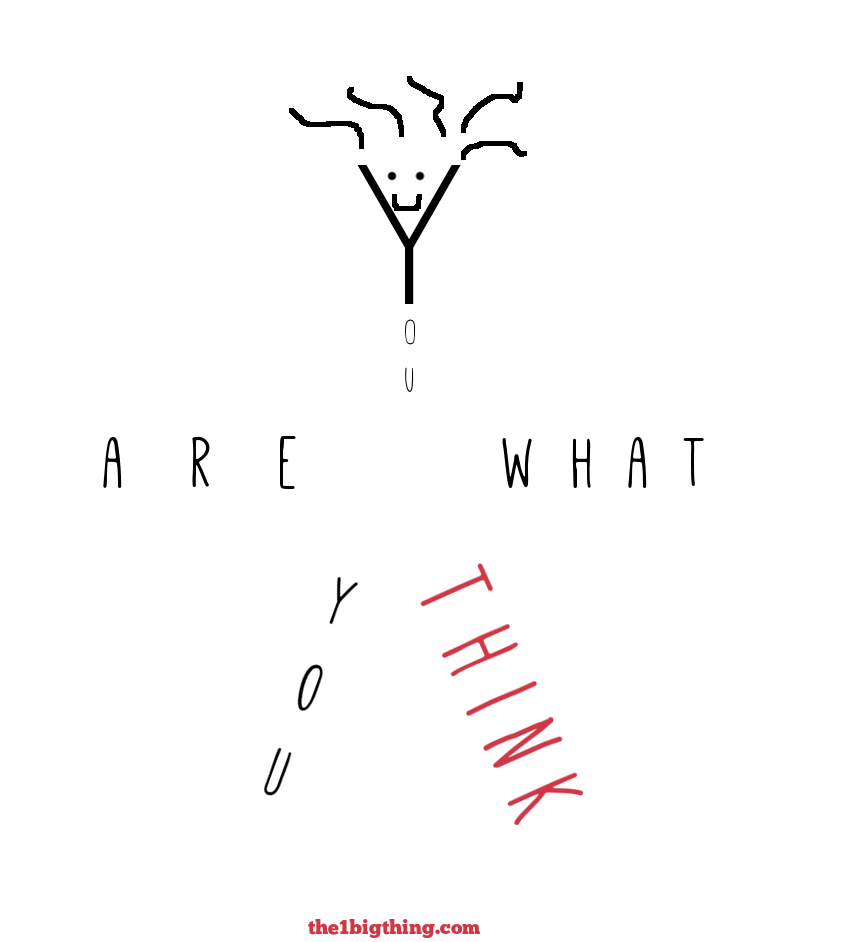
the1bigthing.com - change how you think

In the past 15 years Psychologists have turned their attention to what makes us happy in life. The research is loud and clear, your thinking has a huge impact on this. This post looks at what the research shows is ‘good’ thinking, what is not and shows an easy way to change how you think.

A group of us were discussing the idea of luck during a workshop I was running. One participant piped up, ‘I not one of those lucky ones, I’ve never been lucky and probably never will.’

It was a typical response from someone who has a pessimistic explanatory style. The bad news for this participant is that his thinking makes him right.

When doing research for a book called ‘The Luck FactorRichard Wiseman discovered that people who considered themselves lucky in one area of their life, were usually also lucky in other areas. This led him to believe that luck is not something that occurs randomly, but instead it’s something that people create through their thinking.

Enter Martin Seligman, the father of Positive Psychology, with a fantastic explanation as to the kind of thinking that creates luck in our lives.

We’ve all heard the terms optimist and pessimist, but what do they exactly mean? Seligman studied the patterns of thinking of hundreds of individuals and noticed that people could explain events in two different ways.

Imagine you’ve thrown a dinner party and the food you’ve cooked has been exquisite. The night was a roaring success and all the guests told you how much they loved it.

If you’re an optimist you might think something along the lines of, ‘Wow I’m a great host and a great cook. I’m sure this party was the start of many great evenings with my friends. And you know what, I’m sure I can use these same skills to turn that work event I’m planning into a huge success as well.’

In other words you’ve built up the event. You’ve made it permanent (you can repeat it), you’ve made it personal (it was YOUR skills that created the success) and you’ve made it universal (you’ve applied it to other areas of your life). As a result you feel great!

If you’re a pessimist your thinking might be a little different. You might say to yourself, ‘That was a fluke. I’ll never be able to re-create that food. There was something in the air that made everyone have fun’.

In other words, you’ve played down the event. You’ve made it temporary (you cannot repeat it), you’ve made it external (you had nothing to do with the success) and you’ve kept it specific (you haven’t applied it to other areas of your life). Chances are it hasn’t given you the same boost that the optimist got.

What about when something negative happens? This is where it gets even more interesting. Seligman found that in a negative event the exact opposite happens.

Let’s imagine you’ve applied for a job and you’ve just received a rejection letter.

An optimist would think something like, ‘It was only one job, they probably needed different skills. I’m sure I’ll do better in my other applications.’

The pessimist might think, ‘This is a disaster. I’m sure I’ll be rejected in my other applications too. I’m just not good enough.’

This time the optimist has made the event temporary, external and specific, while the pessimist has made it permanent, personal and universal. As a result the optimist might shrug the incident off, while the pessimist might end up feeling very disheartened about it.

When we break down the idea of optimism and pessimism in such a way it becomes much easier to see why research shows that optimists do better at work, live longer and report more fulfilling lives.

If you like the sound of this, here’s what you can do to think more optimistically in life.

When something good happens ask yourself the following questions:

  1. What part did I play in making this a success?
  2. How can I apply these skills to other areas of my life?

When something bad happens ask yourself these questions making sure you find reasons to say NO to each question:

  1. Is this permanent?
  2. Is this widespread?
  3. Is this personal?


You might want to follow this line of questioning with:

What specific action can I take to get a better result next time?

Psychologists also recommend that we avoid ‘catastrophising’ negative events. Here are two more questions to help with that.

  1. Will this matter in 5 years’ time?
  2. What are the overall consequences? And why are these not as bad as they seem on the surface?

Hope this post helps you think more optimistically about events that happen in your life.

What current event will you apply this strategy to?

With love

Karen

x


Enhanced by Zemanta
Jan 312013
 

the1bigthing.com so you think you're clever?

What have you given up, or never started because you thought ‘I’ll never succeed’ or ‘I’ll never be good enough’? If something’s sprung to mind, read on. This post is about what’s created those thoughts and what to do about it.

Psychologists have discovered that some labels we’re given as kids often have a lot to do with how likely we are to give up on things as adults.

Regardless of whether a label is positive (you’re so clever) or negative (you’re dumb), it automatically puts us in a box and treats our talent, or lack of, as fixed and unchanging. And this is a dangerous thing.

Here’s why…

Labels like ‘talented’ or ‘clever’ subconsciously tell us that we don’t need to put much effort to learn or succeed at something. So when we do have to make an effort we end up assuming that this is because we’re not that talented after all.

Test it out. Who do you think is the better guitar player – someone who’s gifted or someone who’s worked really hard at learning how to play?

See what I mean?

On the other hand labels like ‘rubbish’ or ‘stupid’ tell us that no matter how hard we try we’ll never be any good.

The common denominator in both instances is EFFORT. Both labels ignore it. They assume that our abilities and skills are FIXED, and no amount of effort will make a difference.

So when ‘Miss. Clever’ encounters a task that’s a bit more difficult to master, suddenly her ‘clever’ title is under threat. If she were really that clever she’d find this easy, surely. So ‘Miss Clever’ decides that it’s better to give up and forget about the task because then she could easily tell herself that the only reason she didn’t succeed was that she didn’t try. Her ‘clever’ status goes unchallenged.

Similarly Miss Croaky voice never bothers with singing lessons even though she’d love to sing, because no amount of effort is going to change that voice that sounds just like a fox in a fight (and if you’ve ever heard a fox fight, you know that sound is NOT pretty).

Dr. Carol Dweck defines this as having a FIXED mindset. A belief that ability is unchangeable.

It makes those of us who have been labelled positively expect ourselves to excel at something the minute we start. And if we don’t, we move on to something else lest our ‘genius’ is challenged. The same mindset makes those of us who have been labelled negatively never even try in the first place. Why bother, when it won’t make any difference.

Now if you’re shaking your head at this and thinking, this is absolute garbage - that’s a good thing. It means you’re one of the lucky ones who has a ‘GROWTH’ mindset. A belief that we can master anything….if we put in the effort.

Personally I think we can have both mindsets in different areas in our lives. For example I’ve patiently built my skills at putting websites together as I ‘get’ that it requires effort and yet I’ve given up learning to play the Ukulele because I couldn’t play a proper song when I started.

The good news is that our mindset CAN change! Let’s go back to that goal you gave up on or never started. Take a moment (ok make it 5 minutes) to reflect on these questions:

How much effort have you put into developing this skill so far?

How high are you expecting this skill to be right now?

Are these expectations realistic given the amount of effort you’ve put in?

How much effort ARE you willing to put in?

Given this amount of effort, what would be a realistic goal you can set yourself?

By when do you want to reach this goal?

So what are you going to do about it?

What’s the first step you will take?

When will you take it?

I hope this post inspires you to start something you love.

Wishing you the persistence it takes to make BIG things happen

With love

Karen

x

P.S. This post was inspired by Dr. Carol Dweck’s book: Mindset. It’s full of inspiring stories of how mindset is linked to success in sports, business and school. Read it and let your mindset be transformed.

photo credit: devangmundhra via photopin cc

Dec 052011


Here’s a little secret. Most of our decisions and actions are determined by the voice in our head. Yep, the one that just went…’what voice?’

Whilst this might seem surreal at first, let’s look at it more closely.

We see a new dress, the voice says “that would be perfect for so-and-so’s party next week” and out comes the credit card.

We want to ask for a raise, the voice says “they’ll never give it to me” and so we never set that meeting.

We have a big dream, the voice says “you can never make it happen” and so we don’t do anything about it.

Sounds familiar? If so here’s my early Christmas present. 5 top tips to show that voice who really is boss!


Understand why it’s there

In evolutionary terms, life for human beings has changed at super-sonic speed in the last 100,000 years. We’ve gone from nomadic hunter gatherers to life as we know it today.

Our mind hasn’t had enough time to catch up. It interprets daily modern threats like failure, embarrassment, disappointment, in the same way it would interpret being attacked by a huge lion tens of thousands of years ago.

Our thoughts are there to protect us against such threats. They don’t care if we remain stuck, unhappy or dissatisfied with life. What they care about is keeping us safe. And whilst many years ago that meant staying in our cave, today it means keeping things exactly as they are.


Be aware of it

Most of us are not even aware of this voice that controls so many of our actions. Just like a fish in water, we don’t hear our voice because it’s with us all the time. Becoming aware of it is simple – we just have to pay attention to it. Unfortunately this is much easier said than done, and it requires a bit of practice.

Test it out: Next time you feel discouraged, or de-motivated to do something pay attention to what’s going on in your head. Chances are there’s some thought there telling you how you can’t do it, or there’s too much of a risk or something along those lines.

Remind yourself, ‘there is no lion, there is no lion’.


Give the voice a character

This is one of the more unconventional steps.

The more we ignore our voice, the louder it’s going to scream. It’s a lot more helpful to pay attention to what it’s saying.

That’s doesn’t mean we have to take it seriously though.

Giving it a character can help make it less authoritative. I like to imagine my voice as Donald Duck, warning me in that mumbling, funny voice of his. It’s impossible to take my voice very seriously when it’s talking like Donald Duck.

Pick a character that you find funny or ridiculous and give your voice that character.


Write that thought down

This is a truly magical step.

Our mind loves drama, after all it’s a great strategy to stop us from taking risks. If it had to meekly suggest that we be careful, chances are we would ignore it. So instead it amplifies and exaggerates and makes the threat so scary that it achieves the required result. It freezes us in our tracks.

Whenever I’m coaching a client and we talk about their fears, the very process of saying them out loud often takes away a lot of their power. Some of the most common reactions are ‘that’s not very likely to happen’ or ‘now that I think about it, that fear doesn’t even make sense’.

So go ahead, grab a piece of paper and write down now what scares you from following that big dream of yours.


Damage limitation

If some of the risks you’ve listed above are real, this step is for you.

Next to each risk or threat, brainstorm a few ideas of how you could minimize that risk. Who could help you? Who’s done this before? How did they do it? The more you focus on the elements that you can control, the more manageable that risk will become.

When I was about to move to London to study for my Masters in Psychology I took a £15,000 loan. It was a very real risk. Before taking the loan I talked to other people who had studied abroad and brainstormed a few ideas of my own. Those actions resulted in me finding out about a special ‘study abroad scheme’ for masters students which meant I got very low interest rates, a year’s payment holiday and 10 years to pay off that loan. Suddenly it didn’t feel so massive after all.

Try these steps out, my hope for you is that they stop your voice from deciding for you, letting you do what you really want.

I’d love to hear what you’ve found most useful from these tips. Comment below or email me at [email protected] 


Image by zonepress

Nov 282011
 

This Monday’s blog post is slightly different. For some bizarre reason my thoughts came out in rhyme - the heat of Perth must be getting to me! :)

Here goes - hope you enjoy…

I know a girl, let’s call her Claire

With bright blue eyes and big red hair

She has a dream to write a book

One that’s so good, the crowds it’ll hook


And so quite often she sits to write

A masterpiece, no less, is in her sights

Soon enough her smile, it starts to fade

As doubt creeps in, creates a haze


“But I’m not witty, or clever enough

My ideas are less diamond and definitely more rough

I don’t have a Masters in English Lit

My writing is awful, fit for a twit!”


And on and on her mind will go

Not stopping for air, it’s in such flow

“Whatever gave me this silly thought

My delusional brain I should applaud”


She gets up, moves away from her pen

And paints her nails, all of the ten

She sees the windows are full of grime

And washes them down with water and pine


She keeps herself busy, well into the night

“It’s clear!” she says, “I’ve no time to write!

I’ve pampered, I’ve dusted, I’ve cooked and I’ve cleaned

The last thing I need is a pen and a dream”


And so she ignores how excited she gets

When a new character or plot pops in her head

I will not write, for I just can’t do it

They’ll all laugh at me, I won’t go through it”


You’ve guessed. That book, she never did write

One less great story to share with mankind

No one ever got to enjoy the show

It was kept hidden safely. Claire said “NO”


T’was not lack of wit that stopped her you know

Nor lack of talent, or skill, or ideas to sow

It most certainly was not, lack of literary might

Claire didn’t write, because Claire didn’t write.


What would you do if your thoughts didn’t get in the way?


With love

Karen

xx


Nov 072011
 

There’s a lot of excitement in the science world right now. Physicists have made a discovery that could change the way we look at the world. If true, it will lead to the re-writing of physics books, new ways of explaining natural laws and possibilities that we never considered. It will also mean that Einstein was wrong. The great discovery, which is being re-tested as we speak, is that neutrenos (that’s very small particles to you and me) travel .001 second faster than light. Such a miniscule difference with earth shattering consequences.

It got me thinking about the assumptions we’ve made about our personal worlds. What would happen if we discovered that a limitation we set for ourselves was untrue? What if we discovered that we WERE bright enough, witty enough, clever enough, beautiful enough, wise enough? What earth shattering consequences would it have on our world?

Switch to our mobile site